Hello and welcome back to Sports and Animals, so sorry to keep you all (the glorious half dozen of you) waiting.
As you may have surmised by now I made it back safe and sound from the Southern Hemisphere. I’d like to thank all of the interesting people I met down there, but to be fair their company is to blame for the lack of updates to this site. I had anticipated being alone for long stretches of my trip, and therefore having a lot of time to think, write, edit, etcetera. However backpackers are a friendly bunch (I’d like to think this includes myself) and rather than type away on my ipad I found myself learning Dutch jokes, discussing ‘footy’, and drinking Goon. Entries were left half-finished, cities unchronicled, photos never posted. Oh well, I’m back now and with nothing but time between me and a date with Duke Law, I figured I’d catch up.
To reward your collective patience, I would like to share something I hope you’ll find more interesting than my reflections on Australia; which by the way, was awesome. What follows below is a pet project I’m referring to as the League of Nations – a working title – that I spent some long bus rides brainstorming. Here goes…
It began with an article I once read (and now can’t find) discussing the NBA’s possible expansion to Europe. It’s no secret that US leagues are eager to increase their audience, and the NBA has been playing exhibition games in London for years now, with the thought that one day an expansion team may be based across the pond. However this article pointed out that for travel reasons the NBA would need to stick an entire division of teams in Europe at once, rather than have one isolated franchise attempt to survive on its own. This division would (most likely) consist of teams in five cities: London, Paris, Madrid, Barcelona, and Rome. The interesting aspect of this – to me at least – is how those five cities were chosen among all possible candidates. To be fair those five seem rather obvious choices, but who is to say that Berlin isn’t better than Rome, or whether Spain really needs two teams. The next logical step was to see how an expansion to the rest of the world would play out.
The result is the League of Nations, a hypothetical (duh) 64 team worldwide league to be formed at a later date for a yet undetermined sport. The league is broken into four conferences with 16 teams each, and within each conference are four divisions holding four teams. It’s like two NFLs smushed together, if that helps you with the visual. The main criteria for selection included size (both of the city and country), regional balance, and an effort to avoid geographical overlapping. Infrastructure, Olympic history, the Global Cities Index, and regional balance were also considered.
Hopefully this long and garbled introduction hasn’t turned you off to the idea, because I think the concept is pretty neat even if I’m not the best to execute it. I’ll be “releasing” the league in four parts, starting today with the “Americas” conference. I’ve included some basic reasons as to why certain cities were chosen (or left out) and I’d be happy to hear your thoughts. Please try to keep in mind – as I had to myself – that a worldwide league will never be able to satisfy all of our provincial wants, even if 64 teams does sound like a large number; the world is a big place. Hope you enjoy.
CONFERENCE I: The Americas
Division A: Vancouver, Los Angeles, Chicago, Mexico City
Division B: Toronto, New York City, Atlanta, Havana
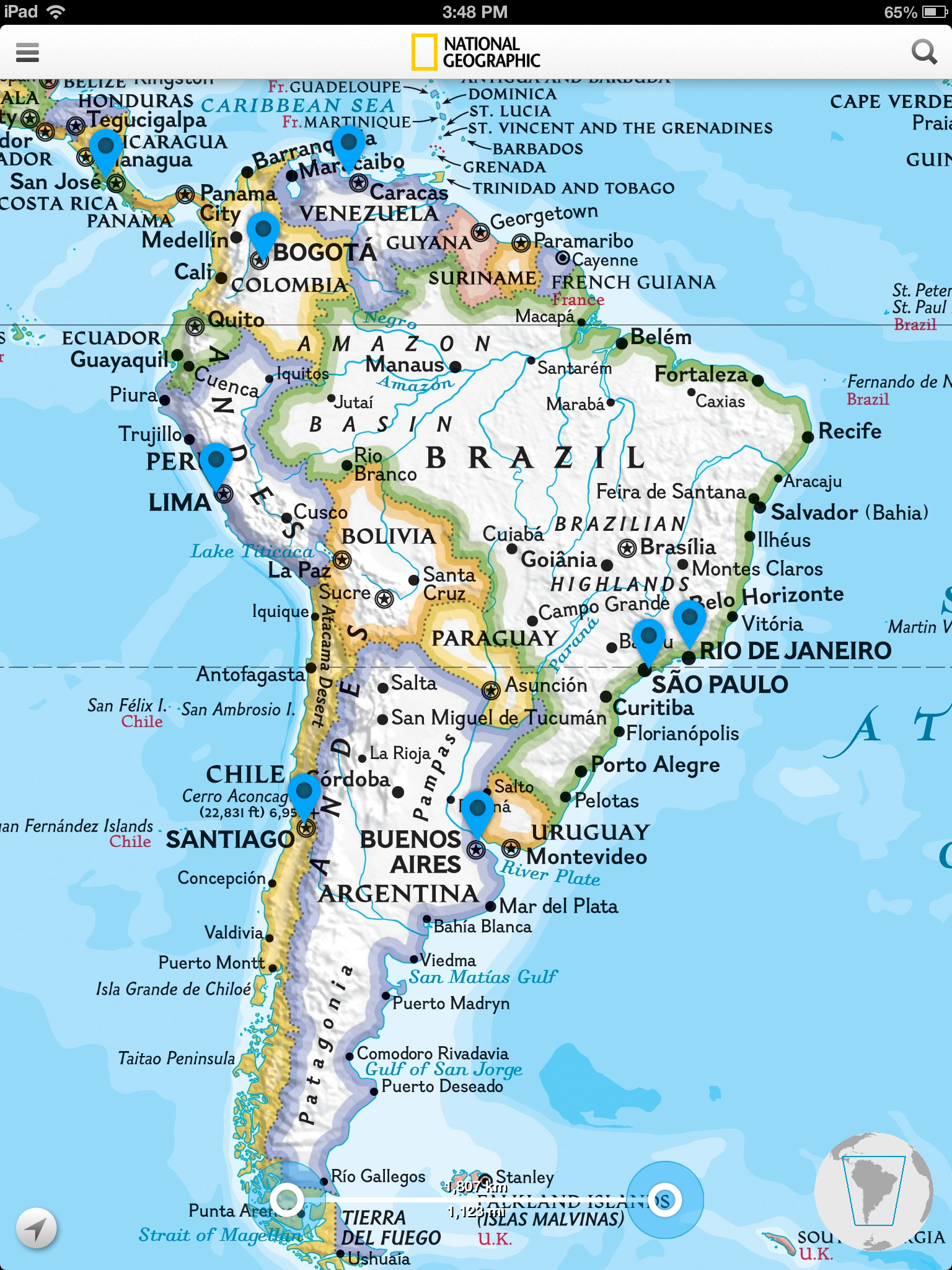
Division C: San Jose, Bogotá, Caracas, Lima
Division D: Rio De Janeiro, Sâo Paulo, Buenos Aries, Santiago
The Reasons why…
Vancouver recently hosted the 2010 Winter Olympics and is an up and coming Canadian city, picked here to represent the Pacific Northwest. It won out over Seattle in my effort to avoid picking too many US teams. (For those curious, the original iteration of the league featured eight American-based teams, now trimmed to four).
Los Angeles is huge, uber-relevant globally (ranked #6 on the AT Kearney Global Cities Index), and tremendously shallow. Sadly I had to go with the home of Hollywood at the expense of beautiful San Francisco, since I wasn’t willing to stick two teams so close together without a deeper division existing between the potential fan bases. For example Barcelona and Madrid get two unique teams (as you’ll see later) because the people of these cities hate each other and fought a war relatively recently. As much as the NorCal v. SoCal rivalry matters to college freshman and baseball fans, it wouldn’t necessarily preclude residents of the Bay Area from supporting a team a little farther south in lieu of their own, nonexistent franchise. Also LA hosted the 1984 Olympics.
Chicago is any easy choice to represent the midwest. With a population of 10 million and a GCI (Global Cities Index) ranking of seven, the windy city deserves its spot. A passionate tradition of sports fans didn’t hurt either, and minor challenges from Detroit and St. Louis were shrugged off.
Mexico City‘s metropolitan area contains over 20 million people, and the city is unquestionably the center of all things Mexican. Another easy choice.
Toronto is the second representative of Canada, and is the highest ranking Canuck city according to the GBI (coming in at an impressive 16th). Quebec made a push on behalf of French-Candiens, but their voices were not heard and the home of the CN Tower shall receive the spot in the L.O.N.
New York City is number 1 overall in the GBI, and is one of just two cities (along with London) given an Alpha++ Global city ranking. By the way, if you find any of these rankings interesting (and who knows maybe you do) you can find them by going to https://en.wikipedia.org/wiki/Global_city
Atlanta is potentially the most controversial of the US teams to be selected. Truth is I had room for one more American franchise, and Atlanta checked the most boxes without repeating geographically. Boston is too close to New York, Washington DC has other things to do besides host a franchise (the Redskins play in Maryland) and Miami’s demographics are covered by Havana’s team. Meanwhile Atlanta is a large city (metropolitan area includes approx. 5 million souls), played host to the 1996 Olympics, and stands as the de facto capital of the American South, despite Sherman’s best efforts.
Havana is probably wishful thinking on my part, but this is a forward-thinking league. I also thought it was a sexier choice than Miami, being that it gets the L.O.N. footprint into one more country. There might be some worries about Havana players bolting their hotel rooms after away games, but I’ll set that issue aside for someone else to deal with.
San Jose was chosen to represent Central America. Frankly I don’t have strong facts to back up all of my selections, so I’ll just say that I was happy with the way San Jose’s marker looks on the map. Also I’ve been hearing great things about Costa Rica (you probably have as well) so I figured they deserved a little something for all their hospitality.
Bogotá is the capital of Columbia, ranks 55th on the GCI, and holds nearly 8 million people within its borders. Columbia as a country holds nearly 50 million people, and I’d like to think they’ll all get behind this team. And because I gave Columbia a squad I had to include their rivals and neighbors Venezuela one as well.
Caracas is Venezuela’s capital, ranks 57th on the GCI, and has a population of approximately 3 million. They also have oil.
Lima has nearly 9 million residents and is the capital of Peru. As you can see I’m not exactly an expert on South America, and these picks sort of made themselves. That doesn’t mean they’re wrong, just relatively uneducated choices. Judge for yourselves.
Rio de Janeiro, assuming it survives the massive amounts of tear gas currently in its atmosphere, will host the 2014 World Cup, 2016 Olympics, and potentially the 2020 World’s Fair. It is in every sense (besides public transportation) a global city, and its widespread (but trending downwards? hopefully…) crime and poverty don’t stand to make it any less so.
Sâo Paulo is Brazil’s second city on the list, and was originally overlooked by me. Rio may get all the headlines, but Sao Paulo is in fact Brazil’s largest city with a metro area of 20 million. Furthermore it ranks an impressive 33rd on the CGI, while poor Rio doesn’t even make the list.
Buenos Aires: another no brainer. Besides being the home of Johnny Rico and friends in Starship Troopers (and getting wiped out by a bug-directed meteor attack) B.A. is the highest-ranked South American city on the GCI, coming in at number 22. Its city limits and suburbs hold 12 of the 40 million people in Argentina, and its fans will look forward to matches against the two Brazilian sides next door.
Santiago has over 5 million residents, a full third of Chile’s population. It’s home to the Metro de Santiago, South America’s most extensive metro system, and really seems to be going places. Montevideo was a tempting choice, but sadly Uruguay and it’s measly 3 million inhabitants didn’t qualify for a team.
Anyway that’s a full quarter of the League of Nations, just as Wilson imagined it I’m sure. You can see the cities pinned on the maps below (click to enlarge). I’ll do by best to get the next segments up in a timely manner. Glad to be back.

 Sports and Animals