Bienvenue to the second installment of the League of Nations. I hope you all were able to scrape some enjoyment out of the first sixteen teams because I’ve got another dozen and a half cities to share today. If you haven’t had a chance to check out the introduction/explanation to the League, please see the post prior (below) this one.
Before I unveil the “Asia” Conference, I’d like to reemphasize just how subjective this selection process really is. I’ve spent an embarrassingly long time on this already and still I find myself changing cities and rearranging divisions at the deadline. There aren’t any right answers, and the necessity of grouping the league has caused plenty of headaches. But it’s still been fun, and I’d love for any of you to chime in with suggestions. Eventually these franchises will need names, so if you’re bored and starting to daydream, maybe direct some creative thoughts my way.
Conference II: Asia
Division A: Tokyo, Seoul, Beijing, Shanghai
Division B: Hong Kong, Taipei, Manila, Bangkok
Division C: Kuala Lumpur, Singapore, Jakarta, Sydney
Division D: Dhaka, Mumbai, Delhi, Karachi
The reasons why…
Tokyo is the largest city in the world, according to 5 of the 6 measures used by Wikipedia (thank you Jimmy Wales), losing out only in the measurement of ‘city proper’. There were no other contenders for the top spot in Japan, and while Osaka may be deserving of a nod (population nearly 20 million), this island nation is only getting one team into the League.
Seoul, assuming the region’s stability holds, should be an extremely productive member of the L.O.N. Thanks to the American military’s benevolent and ultimately successful intervention 60 years ago, South Korea has been able to grow into a vibrant economic powerhouse. And as the capital city, Seoul has become an indisputable member of the world’s elite cities, boasting a metropolitan population of 25 million and coming in at number 8 on the Global Cities Index. It’s a little tempting to also grant Pyongyang a team, given that they do have the world’s largest stadium (the May Day Stadium, capacity 150,000), and that Kim Jung-un would make a better owner than Chris Cohan.
Beijing gets a team, and they are required to play at the Bird’s Nest. Easy choice.
Shanghai. Remember when I said that Tokyo is considered the biggest city in all but one category? Well you’re looking at the city that beat them in the other category (city proper, in case you forgot). And honestly I’d say this is the most relatable measure for sizing up a city. For example, using ‘city proper’ we’d say that the population of San Francisco is approx. 800,000, whereas if we use some of the other measures (metropolitan area, urban area, etc.) the population jumps to as much as five million. For the purposes of sports teams these latter numbers are very important (think of how many people travel to Giants game from outlying areas), but if you are just trying to visualize how big a place is, you’re better off using ‘city proper’. Sorry for that undoubtedly boring rant, sometimes these things just slip out.
Hong Kong is an important city and seemed like an obvious choice. I don’t have much else to say about it, other than that the ‘Hong Kong King Kongs’ would be a cool name for the franchise.
Taipei‘s inclusion serves two purposes: giving China a fourth team (equal footing with the US) and representing the country of Taiwan. Either way the city has tremendous infrastructure, a large population, and a history of winning Little League World Series titles.
Manilla is the capital of the Philippines, and while Quezon City is technically the country’s largest city, both cities fall within the same metro area (conveniently called the Manila Metro). The Philippines contain approximately 100 million people, good enough for twelfth in the world, and surely you’d all agree they deserve a spot in the League.
Bangkok isn’t all cocaine, ladyboys, and face tattoos. It’s also where they filmed The Hangover 2 (ha-ha). In the league Thailand’s capital city will help to represent the approximately 610 million people of Southeast Asia. Also considered for this slot were Hanoi, Ho Chi Min City, and Phnom Penh, but Bangkok’s superior numbers and (projected, planned, possible) infrastructure wins out. Besides I’m sure opposing players will circle games in Bangkok with glee. If professional athletes can find trouble in Milwaukee, I’m sure Bangkok will produce some phenomenal headlines.
Kuala Lumpur might seem undeserving at first glance, but let me throw some stats at you and we’ll see if anything sticks. First off, KL is rated as an Alpha World City (same level as Los Angeles, Madrid, and Beijing). It has hosted the Commonwealth Games and Formula One Grand Prix. About 9 million tourists visit KL a year, making it the sixth most visited city in the world. FInally it should at the least provide some satisfying regional balance and serve as a possible alternative to any Southeast Asian fans who don’t like Bangkok.
Singapore is the only city-state in the League, which is a bit of a bummer, since city-states are awesome (just ask Ancient Greece). Singapore ranks 11th on the GCI, is the world’s fourth-leading financial center, and contains one of the five busiest ports in the world. Oh and did I mention it’s a city-state?
Jakarta. Here’s a ‘fun’ trivia question: What’s the biggest (population-wise) Muslim country in the world? With a population of 237 million, about 90% of which practice Islam, the answer is Indonesia! Isn’t learning fun? Anyway Jakarta is the capital of this archipelago and holds nearly 30 million people within its metro area. Whatever sport the League chooses to adopt (my personal choice would be a reincarnation of Slamball) I’m hoping that the sheer mass of people in the area will lead to a sizable following. Also the main island of Indonesia, called Java, is the world’s most populated island (138 million). The more you know…
Sydney is swell. According to the GCI, it is the world’s 12th most powerful city, and the 2000 Olympics showed that the city is comfortable hosting the world. While Sydney was an obvious choice, I did sadly have to leave out both Melbourne and Auckland. Melbourne is Australia’s second city (the Boston to Sydney’s Big Apple) and impressively hosted the 1956 Olympics. However Australia’s modest population doesn’t warrant two teams in a worldwide league, and for the same reason I had to leave out Auckland, (New Zealand has 4 million people, about the same as South Carolina), despite the City of Sail’s impressive growth.
Dhaka is one of the world’s megacities (defined as having a population of 20 million or more) but most people have never heard of it, myself included. It’s the capital of Bangladesh, a country the approximate size of New York State with a population of 150 million, making it the most densely populated nation in the world. According to Forbes, Dhaka is one of the fastest growing cities in the world, with a population increase of 45% between 2000 and 2010. Hopefully this franchise will be able to capitalize on the explosive growth of the city, and Dhaka will be a household name in the future. Oh, and it’s known as the “city of rickshaws”, another great potential franchise name.
Mumbai, or Bombay, is the largest city in India and the fourth-largest in the world. Interestingly, the city originally consisted of seven separate islands, which were connected over the course of 500 years by different land reclamation projects. Pretty neat.
Delhi is technically a metropolitan area, while New Delhi is the actual capital city of India; for our purposes ‘Delhi’ will suffice. It’s also a megacity, and gives the second largest country in the world a second team. Narrowly left out is Kolkata (Calcutta for your British Imperialists), India’s third largest city. Rather than adding a third team to India I chose to include Dhaka, thereby hopefully including Bangladesh’s immense population. However if the League of Nation ever does expand (and frankly how could it not?) then Kolkata will be among the first cities granted an expansion team.
Karachi: Pakistan’s largest city, and according to Forbes (same article as before), the world’s fastest growing city. It’s the economic and educational center of Pakistan and its inclusion in the same division as India’s two teams should make for some explosive rivalries.
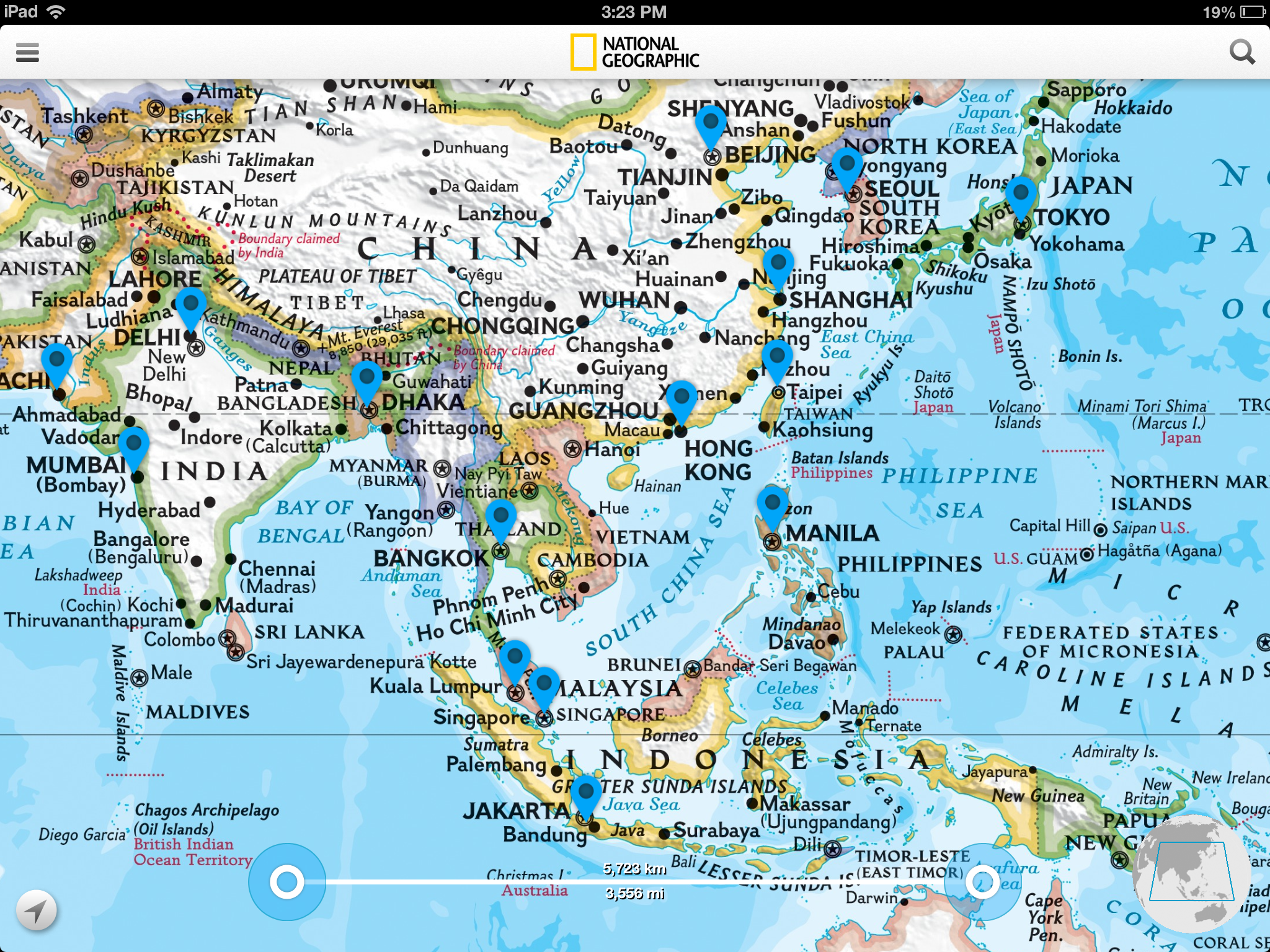
That’s it for this edition of the League, please see below for a map of the teams (without Sydney, but I’ll bet you all know where that is). Next time I’ll be introducing the Middle East/African/Eastern Europe Conference. Hopefully I’ll have thought of a better name for it by then.
 Sports and Animals