Category Archives: Uncategorized

The Champions League to NFL Translator: An Introduction

See, I told you I’d have some sports here soon. (And by you, I do mean you. Not very many people read this; I know who you are).

Anyway, what is a sports translator? The idea comes from Men in Blazers, a soccer podcasting and writing duo of Brits who try to educate us Yanks about the beautiful game. The translator in question takes an American sports team you support and finds the equivalent European soccer team. It’s the lift that helps you onto the bandwagon. Here I’m taking their idea to the next logical step: matching the worlds’ most popular soccer tournament (the Champions League) with America’s beautiful obsession (The NFL).

To catch you all up, here is the Champions League in a nutshell. It’s strictly European teams, 32 to be exact, and entry to the “tournament” is determined by each club’s performance last year. For example, the top four teams in the English domestic league from the 2011-2012 are entered into the 2012-2013 Champions League. The top 3 French Teams from 2011-2012 are entered into the 2012-2013 season as well, and so on. The number of teams each country is allotted is determined by how good that country’s league is, as calculated by a bunch of formulas and junk. (If you want to see exactly how this is calculated and how many teams each country gets, click through here).

As a casual fan, all you need to know is that the Champions’ League contains 32 teams from all over Europe. These 32 teams are broken into groups of 4. The teams in these groups play each other twice (at both teams’ home stadiums) and the top 2 advance from each group. Then the final 16 play in a ‘regular’ tournament with single elimination until there is a winner (except that it’s home and home aggregate with away goals as a tie breaker. But whatever, don’t worry about that part yet).

Finally, let’s turn back to the translating part. In each post I’ll match a group of 4 to an NFL division, which also contains 4 teams. Then I’ll equate the teams, predict the winners, etc. Simple as that. A few disclaimers before I do so though..

1. The NFL has a salary cap, European soccer does not. So the later will be more lopsided than the former. Also some of the countries sending teams to the Champions League are much smaller than their opponents’ nations (I’m looking at you Cyprus). This leads to some very exciting home atmospheres, as millionaire athletes from Spain (for example) have to take a 6 hour bus to reach the stadium of their Ukrainian opponents.

2. Champions League groups are randomly selected and differ every year. This doesn’t leave the same room for simmering, long-standing rivalries that the NFL enjoys. Instead, Champions League fans get to hate each other for entertaining nationalist reasons. For example, English fans despise Italian soccer players for their (perceived) showboating and diving. Russians hate Turks, Germans hate Spaniards, and so forth. Often this turns to most of England blindly supporting their “representative” against the foreign side, even if most of these fans usually despise the team they’re rooting for. The American equivalent would be Alabama fans cheering for LSU to beat Texas, based upon “SEC pride”.

3. The Champions League is sponsored by Heineken, and the NFL by Bud Light. Our football watching experiences are inextricably linked with beer commercials, while Champions League viewing results in the Champions League anthem (sponsored by Heineken) being branded into your forebrain.

4. The above three are built in excuses for why my translator will be flawed. Self-handicapping is the best.

Excellent. So, I think that gives you a taste of what’s to come. Please check in soon as I’ll be telling you why Group A is the AFC West of Europe. (Bad news for Raider fans, you guys are the Croatian team)

Animal of the Week: Civet

The name Civet actually refers to about a dozen different species, but for continuity’s sake I’ll highlight the African Civet below as the group’s representative.

African Civet civettictis civetta

Civets are best described as large mongooses, although you could also imagine them to be otters who figured out how to run. Found in Africa, East Asia, and those islands between Asia and Australia, Civets are nocturnal hunters that will eat anything they can get their paws on. In jungles this means obscure animals and fruits, while in urban environments Civets are known to rummage through trash.

However, these guys are more than just exotic raccoons. In Southeast Asia, the Asian Palm Civet’s droppings help produce the world’s most expensive coffee: Kopi Luwak. Apparently the enzymes in this mammal’s digestive track seep into coffee beans, resulting in much less bitter coffee. I’m not sure how this was first discovered, but since the process doesn’t harm the critter I’m all for it.

“Hey there, I pooped about a mile back. Better go shift through it for some coffee beans!”

Also, Civets produce a musk that is used as a stabilizing agent in cologne. This is less interesting to me than the coffee beans, but I felt it worth mentioning.

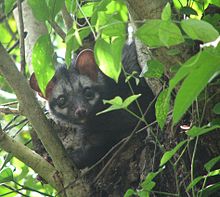
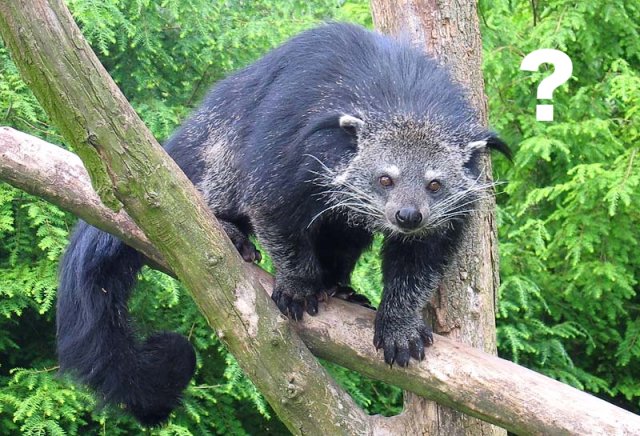
Finally, the main reason that I wanted to feature the Civet was this photo…

As hard as a tried, I could not find what specific species this guy is (although I’m convinced it is a civet*). What I did find was an awesome blog post from someone who spent their childhood in India. He describes the bham, an apparently vicious night terror that decapitates newly-born kittens. That last bit alone is well worth making the Civet the Animal of the Week.


*Correction to this post. Upon further research, I have found that the species pictured above is the Binturong, or Palawan Bearcat. This animal is closely related to civets, but is in a separate genus and so shouldn’t be referred to as a civet. A Bearcat dedicated post is in our collective future.

Thanks as always to wikipedia, this website (which copied my idea for a blog but whatever), and “Joy Forever” who wrote about the bahm,

Animal of the Week: Raccoon Dog

Welcome back, to sportsandanimals.com (more sports to follow, I promise). This week’s installment is the Raccoon Dog.

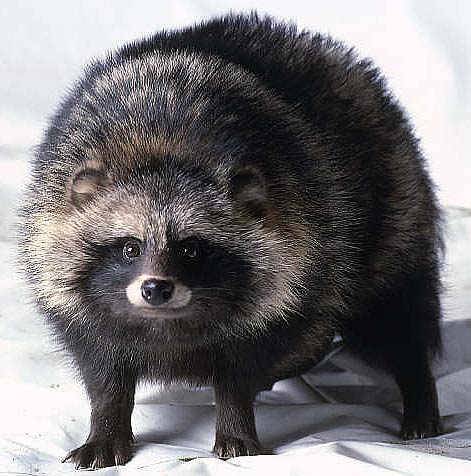
Raccoon Dog Nyctereutes procyonoides

Despite the resemblance, and the nomenclature, this guy is not closely related to the raccoon that we know and love in the US. The Raccoon Dog is in the Canidae (dog) family, and if you had to pick an animal to compare it to, then the fox would probably come closest.

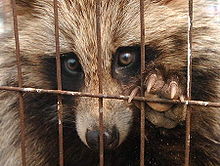
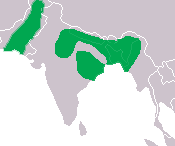
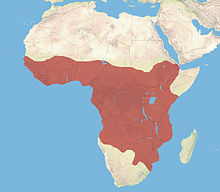
Nyctereutes procyonoides is an omnivore, munching on rodents, amphibians, birds, and all types of fruits and plants. Originally from East Asia (the blue on the range map above), the Raccoon Dog was introduced to Eastern Europe (the red) by the Soviet Union in an effort to increase the quality of the animal’s fur. Unfortunately for this dog, people seem to love the fur (referred to as murmansky fur) and millions are bred in captivity for the fur trade. According to an investigation by three animal rights groups, approximately 1.5 million Raccoon Dogs are raised for fur in China.

Thankfully, the Raccoon Dog is not an endangered species and is fairly common throughout its range. Still, please don’t wear one as a hat.

Thanks as always to wikipedia for the facts and photos, and factzoo.com for one of the photos.

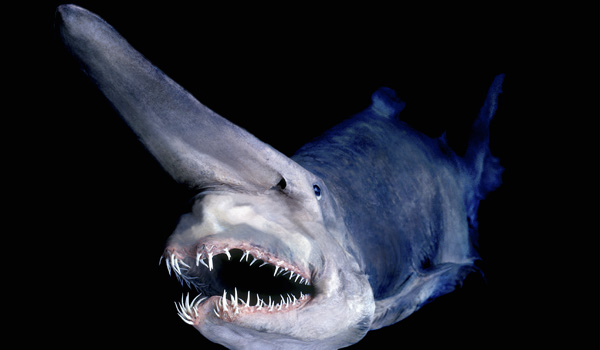
Animal of the Week: Goblin Shark

Goblin Shark Mitsukurina owstoni

This horror is a deep sea dweller that lives in oceans all over the world, but it is most commonly found in the waters off of Japan. The shark averages about 9 feet in length, is colored a light pink, and has an extendable jaw that is the thing of nightmares. The clip below shows these jaws in action (skip to 30 seconds).

While not endangered, the Goblin Shark is usually seen only a few times a year, mostly as an accidental casualty of deep sea fishing. However in 2003 over 100 were caught near Taiwan, a short while after an earthquake had occurred in the area. Needless to say 100 of these guys hunting in relatively shallow water is not reason for celebration, so think twice before swimming after any earthquakes.

Finally, I should mention that the Goblin Shark is not considered dangerous to humans; just scary.

Thank you to Wikipedia, iucnredlist.org, and discovery.com for information and photos.

Animal of the Week: Cassowary

Although there are three extant (not extinct) species of cassowary, this Animal of the Week is the:

Southern Cassowary Casurius Casurius.

The Cassowary is a jungle-dwelling bird that looks a cross between an emu and a turkey. The species stands about four feet tall, lives only in Northern Australia and New Guinea, and according to the Guinness Book of World Records the Cassowary is the most dangerous bird in the world.

This last bit stems from the fact that this large flightless bird has powerful legs which it uses to kick box anyone who comes close. On its feet the Cassowary has long talons (think Velociraptor) that can tear open abdomens. Please see below for an example of a cassowary defending its territory.

Cassowaries mainly eat fallen fruit, but they also ingest snakes, spiders, and assorted jungle things. The name Casso Wary comes from the New Guinea words for Horned Head, and it uses this crest like a battering ram to get through thick bush. If you laughed at this last part. you’re immature.

Thank you for taking a few minutes to learn about the Cassowary. And thank to you Wikipedia, AOL Travel  and Birdlife International for knowledge and images.

Animal of the Week: Gharial

Welcome to the inaugural Animal of the Week. Each week I will present a few facts about an animal and then attempt to convince you that it is awesome and worth your attention. Depending on who you are there is a good chance this second part may not take, but maybe you’ll learn something. Or not I don’t know. But it’s free. Anyway, this week’s animal is the…

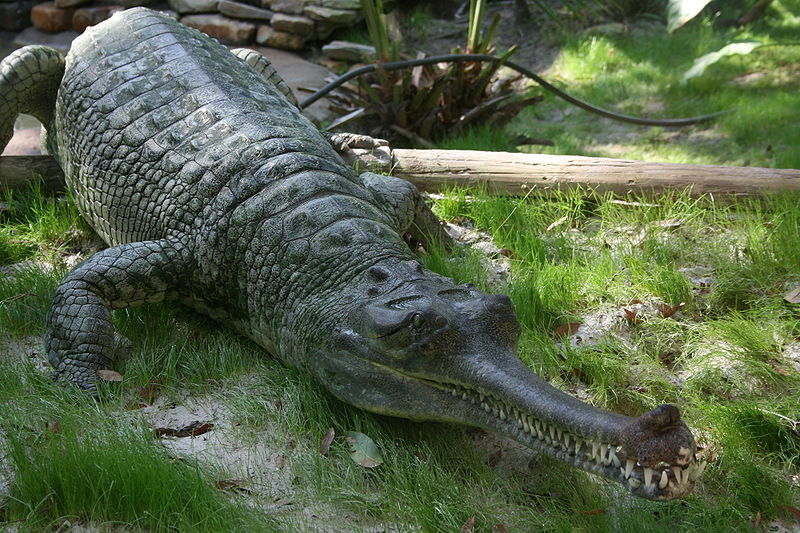
Gharial Gavialis gangeticus

The gharial is a 10 to 20 foot long crocodile found in the rivers of India. While the croc grows to huge lengths (the biggest on record clocked in at 23 feet) they are not a threat to humans. Its long narrow snout is perfect for snatching fish, but too fragile to take down large animals. The species is critically endangered and there may be as few as 200 of them left in the wild. Luckily for us, reptiles are less picky than pandas and attempts to bread them in captivity have been somewhat successful.

I think it’s safe to assume the Gharial (pronounced Gary-ul) has its awful name to blame for its lack of notoriety. How else could such a fearsome-looking, 20 foot reptile fly under the radar? It certainly doesn’t help that there are only a few hundred of the critters left, and that they live in a remote and occasionally powerless part of the world, but still the whole Gh to start a word must eliminate a lot of potential fans. Anyway, if you are interested in keeping the remaining gharials around, please follow this link, or just take public transportation every once in a while and vote Green. And next time someone asks you what the world’s largest reptile is, try and remember that the answer is the Saltwater crocodile. But the Gharial comes in second, and that’s sort of special too.

*thank you to wikipedia for the photos, and for a good chunk of the information. Please email me before suing.