Hi everybody,
Happy boxing day! Did you guys all catch that Liverpool match this morning? No? Well that’s ok they lost anyway.
So with the holidays and a bit of free time on my hands I thought I’d provide some mediocre reading material for my (half) dozens of readers. In this post I’ll be bringing you a bit of information on three lovely animals which have sadly gone by the wayside. Unlike dinosaurs or saber-tooths or Megladons these critters weren’t knocked out of the game due to environmental changes or meteors or whatever. Rather these three were extinguished from God’s Green Earth by greedy humans like ourselves who failed to lay off the hunting and poaching in time. Instead, like the Giving Tree, we took and took until there was nothing left but material for a sad children’s book.
Why should I spend the holidays eulogizing bygone animals? Well, why do we fall? (So we can learn to pick ourselves up). Looking back on past environmental mistakes is a helpful and hopeful way of avoiding new ones. And if nothing else, extinct animal trivia is quite useful I’d imagine; it’s almost certainly been a jeopardy category at some point.
1. Passenger Pigeon (Ectopistes migratorius)
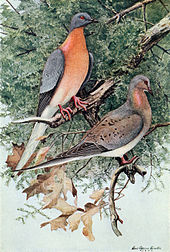
In 1800, there were as many as 5 billion Passenger Pigeons in North America, making it (probably) the most numerous species of bird on the continent. The birds would travel in giant flocks up to a mile wide and nest in enormous colonies numbering in the millions. Understandably, these large gatherings of pigeons were a popular source of food for both Native Americans and early colonists, However the colonists took this hunting to an extreme in the late 19th century when pigeon meat became an extremely popular way of providing food to the poor and enslaved. Hunters engaged in large scale reapings that including burning or cutting down the nest-filled trees and shooting anything that tried to escape. Because the birds traveled in large, tightly-packed flocks a single shotgun blast could easily take down 6 birds, according to Wikipedia. And since the pigeons were so numerous this mass birdicide was not seen as unsustainable (double negative). A few legislatures attempted to pass bills preventing the hunting of the birds but the general populace ignored the laws and the birds continued to drop like insect-birds (flies).
Naturalist Paul R. Erlich noted that the Passenger Pigeon illustrates an important principle in conservational biology, namely that it isn’t always necessary to kill the last two members of a species to cause its extinction. Passenger Pigeons were gregarious birds that were used to breeding in gigantic colonies, so when these colonies fell from the millions to the thousand the reproduction rate dropped precipitously. Eventually there was only one Passenger Pigeon left. Her name was Martha and she passed away at the Cincinnati Zoo on September 1st, 1917 (the zoo now has a statue in her honor). The poor Passenger pigeon went from being the most popular bird in the States to getting hit by a metaphorical bus, except unlike Regina George this little guy never made it to prom. And now I don’t get to add it to my life list either.
2. “Thylacine” Tasmanian Tiger (Thylacinus cynocephalus)

The Tasmanian Tiger was like the Tasmanian Devil except a little bit cooler. The last of its kind (apex marsupial predators), this guy was once found throughout Australia, New Guinea, and Tasmania. Before British settlement of Australia it was pretty much only found on Tasmania, and by about 1900 that island was officially the land of its last stand.
In essence the Tasmanian Tiger was the Australian version of a coyote, except that this title probably belongs to the dingo. So it was more like the Tasmanian version of a coyote, with a pouch and stripes. This coyote-dingo-likeness was its downfall as Tasmanians were quite prejudicial to the beast. The locals thought of the tiger as a chicken and sheep stealer and placed bounties on the Thylacines. Like other apex predators, there were never a great deal of Tasmanian Tigers in the first place since local ecosystems only supported a few of them at a time. So once farmers were rewarded for gunning them down, the boys never stood much of a chance. The last known Tasmanian Tiger perished at Hobart Zoo on September 7th, 1936. Now September 7th is recognized in Australia as National Threatened Species Day, so that’s nice.
3. Baiji (Lipotes vexillifer)

The Baiji, also known as the Chinese River Dolphin, is probably gone now. The main reasons for this species’ bucket-kicking include pollution, damning of the river, and accidental capture in fishing nets. In 1950, there were approximately 5,000 of these lovely cetaceans in the Yangtze river. This number dropped to 300 by the 80’s, and an expedition up the river in the 90’s found a mere 13. A recent survey in 2006 turned up a whopping zero dolphins, and the species has been declared functionally extinct. While it is possible that a handful of Baiji are still swimming around in the Yangtze these individuals would not be enough to support a sustained population. In the immortal words of Ice Cube, don’t call it a comeback.
So that concludes my holiday list of ghost animals. Thankfully the environmental world is not all one of doom and gloom. Success stories do exist. Like the California Condor, which was once down to a mere 22 in 1987 and has now number over 430 birds (big thanks to the San Diego Zoo on that one). Also crows and ravens seem to be doing just fine. So there’s that. (Birding tip of the day: How do you tell a crow apart from a raven? The easiest way is to look at the tail. Crows have rectangular tails, while ravens was wedged tails. Next time you’re outside feel free to play “crow or raven?”, it’s more fun than it sounds).
Well I hope you all learned something. Have an awesome new year and remember to recycle any empty glass bottles you may find at your house/apartment come January 1st. Also take Michigan State +5.5 in the Rose Bowl. I still think Stanford will pull it out but it’ll be a close one.
 Sports and Animals
Props for citing Wikipedia James. Breathtaking reporting from a true gentleman
Thanks sugar
Dinosaurs aren’t extinct. Birds are dinosaurs, duh! I strongly recommend you revise this text, lest someone be misinformed.